

Why Do I Quit Exercising? And How To Fix It

“Why do I quit exercising?” is the million-dollar question. The answer might be obvious to you. You may cite lack of time, family obligations, not knowing what to do, fear of injury, other health problems that impede regular exercise, or maybe a lack of motivation. Your reasons for not exercising or quitting after starting are valid. The thing is, people live similar lives to yours and still maintain an exercise habit for life. The next question is, “What makes them different?” As a researcher in public health and a coach, I use scientifically backed research to identify the problems and provide practical recommendations to help you start and stick with it.

Quality of the data
Surfing on the internet for answers can be overwhelming and exhausting. You may find conflicting information regarding exercise from seemingly trustworthy sources. That is why this first main paragraph is about the quality of data and information. Also, I could not spare you from the torture of scientific methodology since my master’s in epidemiology is all about reviewing study designs and analysis. Do not worry, I will keep it short.
The source of my information for this article comes from a systematic review published in the International Journal of Behavioral Nutrition and Physical Activity in 2012. A systematic review is a type of study design that analyzes the data from multiple other studies. In the hierarchy of evidence, systematic review study design sits at the top of the pyramid, above randomized controlled trials. In general, as you move up the pyramid, the strength of evidence increases (See Image Below). A major advantage of the systematic review design is that it focuses on one topic and analyzes multiple other studies that include the same topic. The other studies analyzed by the systematic review can consist of other designs that sit at different levels of the pyramid. The data you are receiving now is a systematic review that includes and analyzes 66 empirical studies. Therefore, the information I am providing is a summary of multiple studies.
The systematic review for this article reported no conflicts of interest, and it was published in a peer-reviewed journal.
Now let’s get into it.
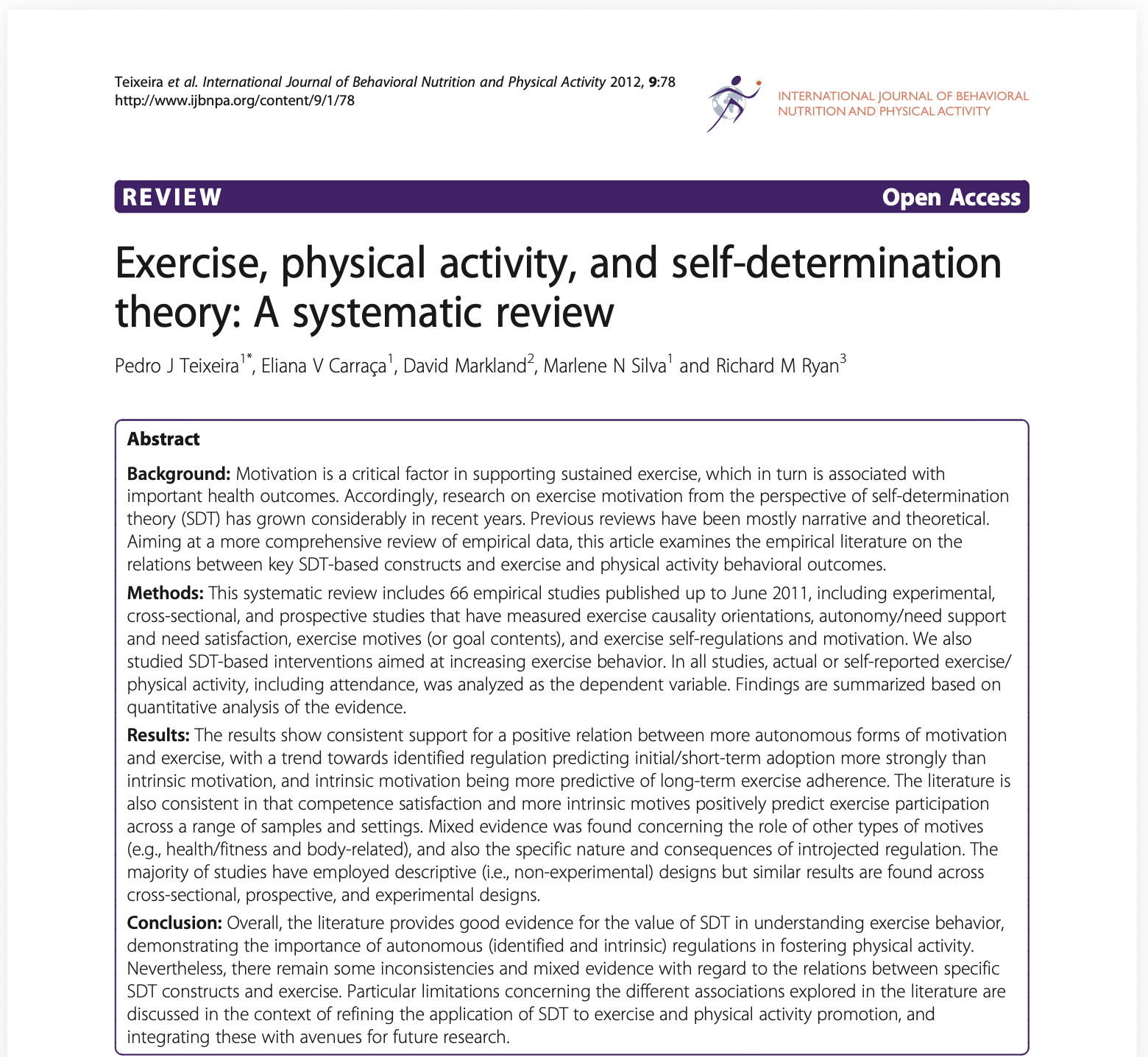
Please note that in this post, all citations and values come from this study.
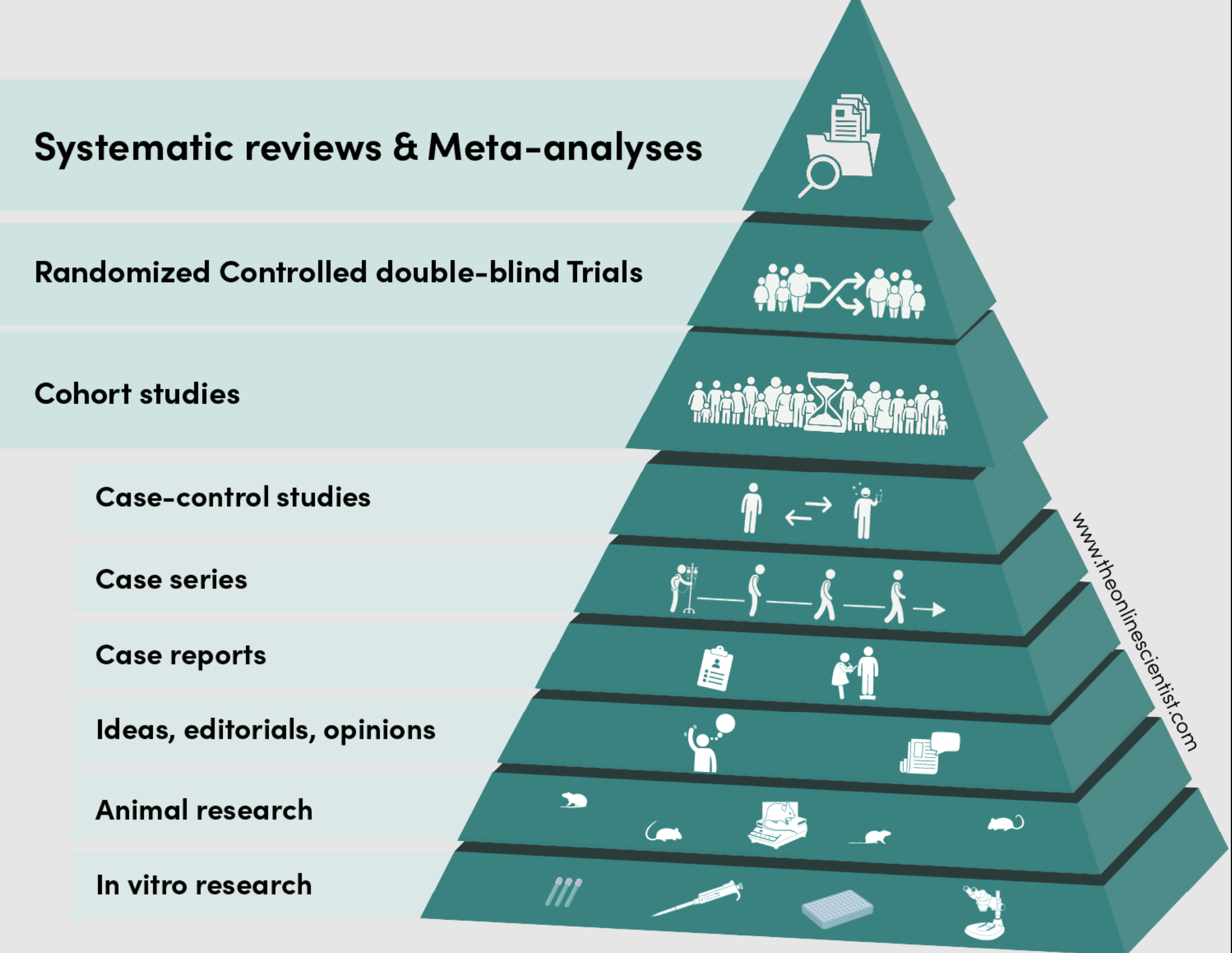
As you move up the pyramid, the evidence becomes stronger.
YOU DON’T HAVE THE RIGHT KIND OF MOTIVATION
Why do I quit exercise? First of all, that is the wrong question; instead, ask yourself, “Why am I exercising?” Some of the more common responses I receive from clients are:
I want to lose weight
I want to get visibly stronger
I am dealing with a chronic condition, but I still have to exercise
I don’t know what to do
I want my butt/biceps/abs to look amazing
I want to feel healthy
All of these reasons are honest and valid. There is no wrong answer. But let’s use research to frame these reasons into the correct mental context. By contextualizing your reasons, you gain a better understanding of WHY you show up to a workout. When you know why, you increase your motivation to work out, but not all motivation is built the same.
BEHAVIORAL REGULATION
The systematic review found that the “vast majority of studies included an examination of the relations between behavioral regulation and exercise behavior.” Generally speaking, behavioral regulation is how you internalize motivation. The motivation you internalize affects your exercise behavior. There are different types of behavioral regulation. The two main categories of behavioral regulation stem from intrinsic and extrinsic motivation. “Extrinsic motivation refers to doing an activity for instrumental reasons, or to obtain some outcome separable from the activity per se. For example, when a person engages in an activity to gain a tangible or social reward or to avoid disapproval, they are extrinsically motivated”. On the other hand, “intrinsic motivation is defined as doing an activity because of its inherent satisfactions. When intrinsically motivated, the person experiences feelings of enjoyment, the exercise of their skills, personal accomplishment, and excitement”.
Let’s revisit the responses my clients typically provide regarding their motivation to exercise.
I want to lose weight
I want to get visibly stronger
I am dealing with a chronic condition, but I still have to exercise
I don’t know what to do
I want my butt/biceps/abs to look amazing
I want to feel healthy
It may seem that the majority of the responses are extrinsically motivated, but it really depends on the sentiment and thought behind it. If I want a fuller butt or bigger biceps because my partner prefers bigger butts and biceps, then that would fall under extrinsic motivation. But if I truly value having those traits and it brings self-satisfaction and excitement, then it could be categorized as intrinsic motivation. Funny enough, this discussion on intrinsic and extrinsic motivation is very similar to identifying your essential values, which I wrote about in my previous post; check it out.
Why does the root of your motivation matter? And what you can do right now
Research shows a very strong association between intrinsically motivated people and building a lifelong exercise habit in comparison to extrinsically motivated people. Likely, a trait difference between those who exercise consistently and those who do not is the source of their motivation. It is likely that you have a combination of both types of motivation, but you have not formally identified them.
I want you to sit down with a pen and paper and reflect on WHY you are beginning an exercise regimen or WHY you are exercising right now. Ask yourself, “What is motivating me to get my workout done?” Give yourself grace for past lapses but be honest with yourself. Do some soul-searching and write down everything that comes to mind regarding your motivation. After you brainstorm your reasons, categorize them as extrinsic or intrinsic motivation. Simply categorize them; do not label them as “bad” or “good”. If you found that all of your reasons are extrinsic, you now know that you must find a deeper connection to your exercise habit. I suggest reframing them. For example, if I wrote down “I want abs,” I ask myself, “Why did I write that down?” If the reason is so I can get a lot of likes on Instagram (extrinsic), I look inward. A possible intrinsic reframe could be “I want abs because I want to feel the satisfaction of achieving a goal, plus it will motivate me to eat better and be more consistent with my workouts to achieve a goal I set for myself.”

Remember Your Goals & The Consequences of External Motivation
In addition to understanding your motivation, several of the articles within the systematic review suggest that intrinsic motivation is not enough to stop you from lapsing. They suggest that you must keep the desired health outcomes of exercise in mind. The outcomes are your objective health goals. For example, even though you may not feel like showing up to your workout, you say to yourself, “I must exercise today because the doctor said I am pre-diabetic. This exercise session will help me keep my weight and blood sugar in check.” While this motivation can seem extrinsic because you are not doing it for self-satisfying reasons but because an external source demands it, it may provide sufficient motivation for you to show up. Some of the studies in the systematic review suggest that identifying with your health outcome provides more adherence to consistent exercises versus intrinsic motivation. But the results from these studies were a mixed bag.
As a coach, I would highly suggest that you keep your “health outcomes” in mind. To put it simply, write down your health goals using the SMART process. Make sure they are specific, measurable, achievable, relevant or realistic and time-bound. I recommend that on days when you lack intrinsic motivation, do the workout anyway because of your identified health goal.
Although focusing on your objective health goals may help you adhere to your workout program, relying on external motivation only does not work out well. In the systematic review, 43% of the studies demonstrated “a negative association between external regulation and exercise behavior,” and in the remaining 57% of the studies there was no association. The key takeaway is that external motivation is weak and unreliable and often undermines adherence compared to intrinsic regulation.
COMPETENCE: KNOWING WHAT TO DO IMPROVES FOLLOW-THROUGH
Reframing motivation and identifying your goals can improve your adherence to exercise, but it won’t change your competence or fear of getting injured during exercise. You can have all the intrinsic motivation in the world, but if you don’t know how to exercise, it can stop you from engaging in the behavior. In the systematic review, the psychological feeling of knowing what you're doing is referred to as competence. As in, I feel competent in my ability to exercise. The systematic review “showed that competence was positively associated with physical activity in 56% of the independent samples”. Clearly showing that knowledge is empowering. Knowing what you are doing can increase your follow-through.
This is especially critical for populations with chronic illnesses. For example, I’ve worked with many clients with chronic illnesses like fibromyalgia, hypermobility, post-exercise malaise, and postural orthostatic tachycardia syndrome (POTS). Many of these clients have the motivation and goals but need personalized attention so they can actually exercise. I work closely with these clients to teach them what they CAN do during a flare-up. Providing them with autonomy and increasing their competence increases the likelihood that they can engage in exercise at their capacity level despite their illness instead of lapsing.

A SUPPORTIVE ENVIRONMENT HELPS
Finally, let’s talk about the cheesy gym mantras about “being a family” or the cultish vibe we get at some studios. I understand this can feel cringey, but it works! Mostly. The systematic review indicated that “environments perceived as more need-supportive were positively associated with increased levels of self-reported physical activity” in half of the samples. Overall, including yourself in a supportive environment can help you keep exercising. This is why I always recommend attending group fitness classes like yoga. It generates a sense of community and accountability.
KEY TAKEAWAYS
Quitting exercise isn’t just about time, health, or family obligations — it’s about the type of motivation driving your behavior. Research shows that intrinsic motivation (exercising for enjoyment, satisfaction, or personal accomplishment) is the most reliable predictor of long-term adherence, while external motivation (doing it for rewards, approval, or pressure) is weak and often undermines consistency. Still, identifying with meaningful outcomes — like preventing disease or improving health — can help sustain effort when intrinsic drive is low.
To build a lasting habit, focus on:
Reframing motivation: Connect your workouts to values that matter to you.
Setting SMART health goals: Use clear, measurable outcomes to stay accountable.
Building competence: Learn proper techniques to reduce fear and increase confidence.
Finding supportive environments: Surround yourself with communities that encourage autonomy, belonging, and growth.
I understand that having intrinsic motivation to exercise won’t drive your kid to soccer practice so you can have that extra hour to work out, or that building a SMART goal won’t magically fill you with an endless amount of motivation to hit the gym. I will say, however, that nobody has time to work out, yet many do. It all depends on what you truly value and the cost-benefit the behavior has in your life. The cost ultimately is your health; the benefit is quality-of-life longevity. Next time you feel like quitting, follow the recommendations in this post. If you want to chat, schedule a virtual call with me so I can answer any questions.
My Plug
My intention with my virtual coaching services and classes is to create lifelong exercisers. I follow the research to not only design workouts, but also create how-to exercise videos so my clients increase their competence. We also have monthly coaching calls, DM via my app, and clients fill out weekly check-in forms to discuss goals, barriers, and increase the level of support. If you’re not sure if coaching is right for you but you want to start getting active, I highly suggest my virtual Sunday yogaStrength class.

See you soon!
:)
